The End of the IDE? What Cursor 3 Reveals About the Future of Coding
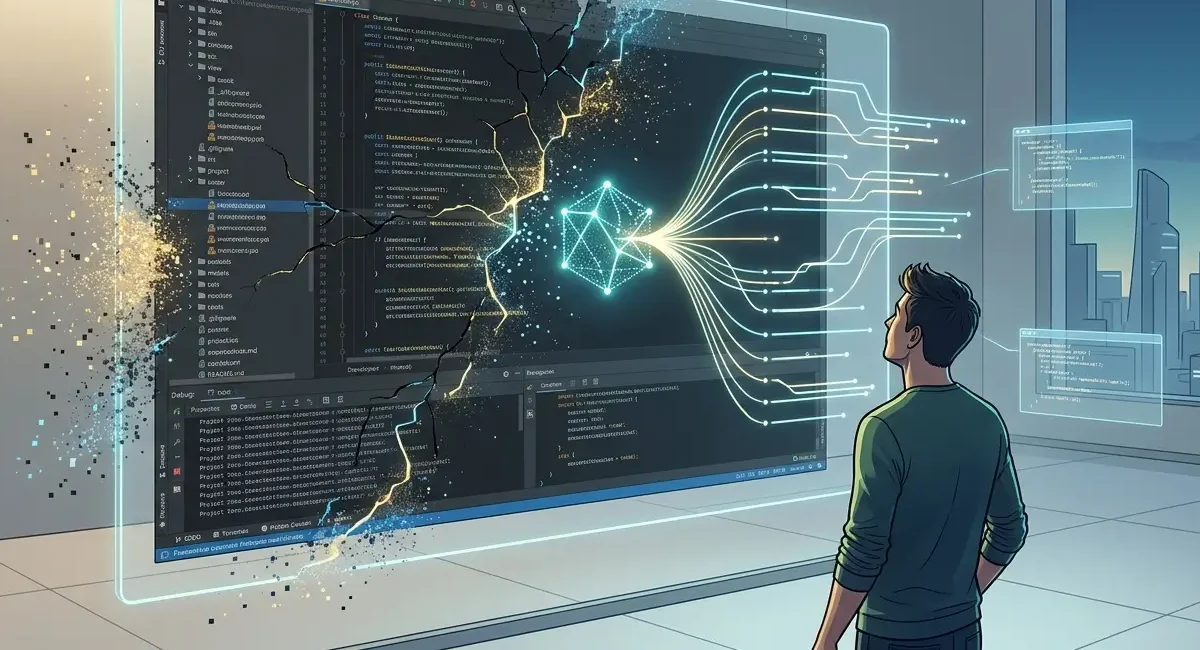
On April 2, 2026, Cursor released Cursor 3, a product update that signals a deeper transformation in how software is built. What began as “AI-assisted coding” is now evolving into something fundamentally different: agentic software engineering.
In this new model, developers are no longer writing code line by line with AI suggestions. Instead, they assign tasks to autonomous agents that execute, iterate, and refine code independently. The developer’s role shifts from creator to orchestrator.
This is not just a feature upgrade. It is a redefinition of the interface between humans and software systems.
From Assistance to Autonomy
For the past several years, AI coding tools have operated as assistants—enhancing productivity through autocomplete, suggestions, and debugging support. This model preserved the traditional structure of software development: humans wrote code, AI accelerated the process.
Cursor 3 breaks from that paradigm.
By introducing an “Agents Window,” the platform enables developers to deploy multiple AI agents simultaneously. One agent can refactor architecture, another can generate test cases, and a third can update documentation—all in parallel, across local and cloud environments.
This represents a shift from linear workflows to parallelized execution.
The data reflects how quickly this model is being adopted. By early 2026, users relying on agents outnumber those using traditional autocomplete by a factor of two. In less than a year, the dominant mode of interaction has inverted.
The New Role of the Developer
As agents take on execution, the role of the developer evolves.
Instead of focusing on syntax and implementation details, developers increasingly define intent, constraints, and outcomes. They review outputs, guide direction, and intervene when necessary—but they are no longer the primary producers of code.
This transition mirrors earlier shifts in technology. Just as cloud computing abstracted infrastructure management, agentic systems are abstracting software construction.
The result is a higher-level interface—one where the primary skill is not writing code, but managing systems that write code.
Parallelism as a Productivity Multiplier
One of the most significant advantages of the agentic model is parallelism.
Traditional development workflows are inherently sequential: write code, test it, debug it, document it. Even with automation, these steps often occur in order.
Agent-based systems break this constraint.
By running multiple agents concurrently, developers can compress development cycles dramatically. Tasks that once took hours or days can now be executed simultaneously, with results aggregated and reviewed in near real time.
This has implications not just for speed, but for how teams are structured and how projects are managed.
Managing Context at Scale
A key technical challenge in agentic systems is maintaining context over extended workflows. Large language models operate within finite context windows, limiting their ability to track long sequences of actions.
Cursor 3 addresses this through a technique called “self-summarization,” where agents compress their own histories—reducing thousands of tokens into more manageable representations.
This allows agents to sustain longer, more coherent workflows without losing track of prior decisions. It also points to a broader trend: as AI systems become more autonomous, managing memory and context becomes as important as generating output.
The Interface Is the Innovation
While much of the attention around AI focuses on models, Cursor 3 highlights the importance of interfaces.
The introduction of an Agents Window—and features like “Design Mode,” which allows developers to interact with UI elements directly—reshapes how work is organized and visualized. The IDE is no longer just a place to write code; it becomes a control center for coordinating intelligent agents.
This positions Cursor in direct competition with tools like Claude Code and OpenAI Codex, each exploring different approaches to agent-driven development.
The differentiation is no longer just about model performance. It is about how effectively users can collaborate with those models.
From Developers to Orchestrators
The commercial success of this shift is already visible. Cursor’s annualized revenue surpassed $2 billion in early 2026, reflecting strong demand for tools that abstract complexity and amplify productivity.
But the deeper implication lies in how it changes the nature of technical work.
Junior developers, traditionally responsible for writing boilerplate code or styling interfaces, may find their roles transformed. Tasks like writing CSS or generating test cases are increasingly handled by agents. The human contribution moves toward oversight, validation, and higher-level design.
This does not eliminate the need for developers. It changes what it means to be one.
Strategic Implications for Organizations
For business leaders, the rise of agentic interfaces raises important questions:
- Talent strategy: What skills will define high-performing engineering teams in an agent-driven environment?
- Productivity metrics: How should output and efficiency be measured when work is distributed across humans and AI agents?
- Tooling investments: Which platforms will best support scalable, collaborative development workflows?
Organizations that adapt quickly may gain significant advantages in speed, cost efficiency, and innovation capacity.
The Obsolescence of the IDE?
The traditional integrated development environment (IDE) was designed for a world where humans wrote code. As that assumption changes, so too must the tools.
Cursor 3 suggests that the IDE, as we know it, may be giving way to something new—a hybrid environment where humans and autonomous agents collaborate.
This does not mean the disappearance of development tools. Rather, it signals their evolution into systems that manage complexity rather than expose it.
A New Paradigm for Software Creation
The shift from assistance to autonomy is not unique to coding. It reflects a broader trend across knowledge work, where AI systems are moving from tools to collaborators.
In software development, this transition is particularly visible because of the structured nature of the work. But its implications extend far beyond engineering.
As agentic systems mature, they may redefine how organizations approach problem-solving, decision-making, and execution.
The Future of Work, Written by Machines
Cursor 3 offers a glimpse into that future.
By transforming developers from writers into orchestrators, it challenges long-held assumptions about creativity, productivity, and expertise. It suggests that the most valuable skill may no longer be the ability to produce output, but the ability to guide systems that produce it.
In this new paradigm, the question is not how well you can code. It is how effectively you can collaborate with intelligence that does.